
Plain English: why your AI keeps making things up, and the architecture that fixes it.
Why RAG Stops AI Hallucinations
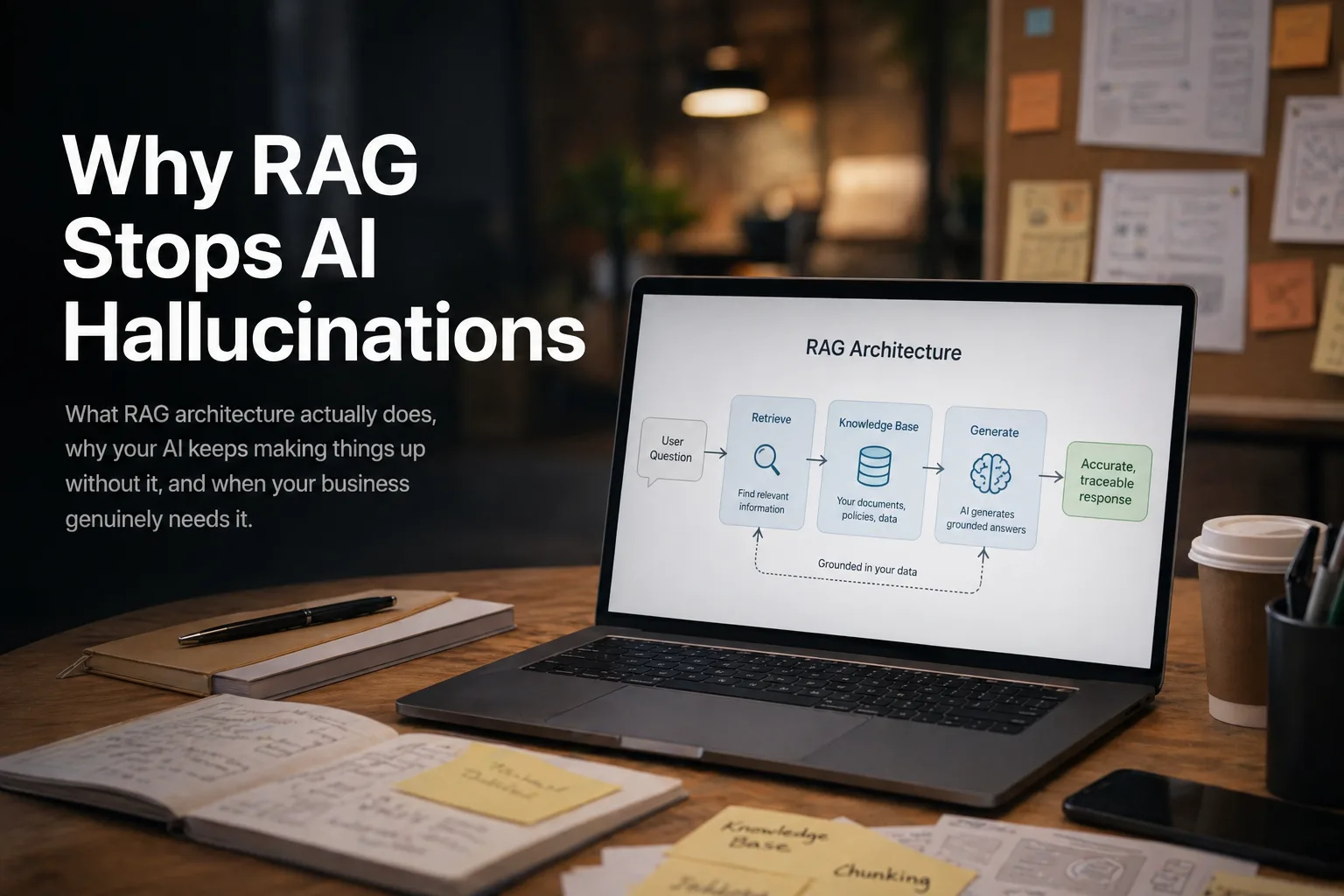
Ask a generic AI assistant a specific question about your company, your contracts, your policies, or your products, and watch what happens. Half the time you'll get something useful. The other half you'll get a confident, well-written answer that's completely made up.
That's a hallucination. And it's not a bug. It's how the model works when you haven't given it anything to work with.
This is where RAG comes in. RAG, retrieval augmented generation, is the architectural difference between AI that's a clever toy and AI that's actually useful inside a business. If you've heard the term thrown around and want to know what it means in plain English, why it matters, and whether you need it, this is the read.
Key Takeaways
- AI hallucinations happen because language models are pattern matchers, not fact databases. Without grounding, they generate plausible-sounding fiction.
- RAG (retrieval augmented generation) gives the AI your specific documents before it answers, so responses are grounded rather than guessed.
- A RAG system has four moving parts: a knowledge base, a vector database, a retrieval step, and the generation step.
- The technology is mature. Most RAG projects live or die in the upstream work, knowledge curation, chunking, and retrieval design.
- RAG is the right shape for question-answering, document search, internal knowledge tools, and customer support. It is not the right shape for every problem.
Why AI hallucinates in the first place
A large language model is a pattern matcher trained on a huge slice of the internet. It does not have a database of facts it looks things up in. When you ask it a question, it generates a response that statistically resembles the kind of answer that should follow your question.
Most of the time, for general topics, that works well. The model has seen enough about French cuisine or Python syntax that the statistical answer is also the correct one.
But ask it about your specific forty-seven page contract with a supplier. Or your internal returns policy. Or last quarter's sales figures. The model has never seen any of that. It still has to produce something that statistically looks like a good answer. So it generates plausible-sounding fiction.
The model is not lying. It is doing exactly what it was built to do, just with no actual information to anchor its answer.
So what is RAG?
RAG stands for retrieval augmented generation. The idea is simple: before the model generates an answer, you give it the relevant information first.
Picture it like this. You hire a brilliant new assistant. They're sharp, articulate, they write beautifully. But it's day one and they don't know anything about your business. Ask them about your refund policy and they'll either admit they don't know, or guess.
RAG is the equivalent of saying, before you answer any question, go to this filing cabinet, pull out the relevant documents, read them, then answer based on what they say.
Now your assistant is grounded. They're not making things up. They're answering from your actual content. And if there's nothing relevant in the cabinet, they can say so.
That shift, from guessing to grounded, is the whole point of RAG architecture.
How it works under the bonnet
Light technical detour. Skim it if you'd rather skip the mechanics.
A RAG system has four moving parts:
- A knowledge base. Your documents, policies, product information, manuals, support tickets, whatever you want the AI to know. These get broken into chunks and turned into mathematical representations called embeddings.
- A vector database. Where those embeddings live. Pinecone, Weaviate, Azure AI Search, pgvector, plenty of options depending on your stack.
- A retrieval step. When a question comes in, the system finds the chunks most relevant to it by comparing the question's embedding to the embeddings in the database.
- The generation step. The retrieved chunks get passed to the language model along with the question. The model answers using that material as its source.
That's it. The clever bit is in the retrieval, the chunking strategy, and how the prompt is constructed. The principle is straightforward.
What changes when you use RAG
A few things shift the moment you have a properly built RAG system in place.
Answers become traceable. A good RAG implementation can cite which document a piece of information came from. That matters for compliance, for trust, and for debugging when something goes wrong.
The AI can say "I don't know." Because the model now has context, it can recognise when the context does not cover the question, and respond honestly rather than confabulating.
Updates don't require retraining. Change a policy document, the AI knows the new policy from the next query onwards. No model retraining, no fine-tuning runs, no waiting weeks for a new version.
Specificity becomes possible. "What's our standard payment term for vendors in Germany?" is a question a generic AI can't answer. A RAG-enabled AI built on your contracts and procurement docs can.
Do you actually need RAG?
Honest answer: it depends on what you're using AI for.
You probably don't need RAG if you're using AI for general writing tasks, brainstorming, or coding help. You don't need it if the information you need the AI to know is widely public and well represented in its training data. And if you're at an early experimentation stage and just exploring what's possible, RAG can wait.
You probably do need RAG if you want AI that answers questions about your business, your customers, your contracts, or your products. You need it if accuracy actually matters and made-up answers carry a real cost, whether that's legal, financial, or reputational. You need it if you want internal teams to query company knowledge without trawling through SharePoint. And you need it if you're building a customer-facing assistant that has to reflect your specific policies and offerings rather than the average of every company that ever existed.
A useful gut check: if a wrong answer would cause a real problem, you need the AI grounded. RAG is how you ground it.
Is RAG expensive?
Less than people tend to expect. The model calls cost the same. The vector database is usually a small monthly bill. The real cost is in doing it properly: deciding what goes in the knowledge base, chunking documents sensibly, building good retrieval, and testing it against the kinds of questions your users will actually ask.
That's where most RAG projects live or die. The technology is mature. The thinking around it is what separates a system that genuinely helps from one that's still hallucinating, just with extra steps.
A RAG system is only as good as the knowledge you put into it and the retrieval logic that pulls from it. Garbage in, confidently wrong answers out. Most of the work is upstream of the model.
Where humans still belong
It's worth saying this plainly. RAG does not remove the need for human judgement. It changes where you spend it.
You spend it on what goes into the knowledge base. You spend it on reviewing what the system surfaces in early use. You spend it on the edge cases the retrieval misses, and on tuning when patterns emerge.
What you stop spending it on is reading the AI's output suspiciously every time, wondering whether it just invented a clause. That's the trade. Human attention moves from babysitting individual answers to designing the system that produces them.
Done well, the workflow runs on its own where it has earned the trust, with people stepping in where their judgement actually adds value. Done badly, you've automated the wrong loop and created new problems.
RAG isn't the whole story
A quick note before this turns into a love letter to one architecture. RAG is a brilliant fit for question-answering, document search, customer support, and internal knowledge tools. It is not the right shape for every problem.
Tasks that need the AI to take actions, follow multi-step procedures, or work across systems benefit more from agent architectures, sometimes with RAG sitting inside them as one component. Tasks that need deep stylistic mimicry might benefit from fine-tuning. Tasks that are genuinely just creative or general purpose don't need any of this.
The job isn't to use RAG everywhere. The job is to match the architecture to the problem. AI where it helps, in the form that actually fits.
The bigger point
Most of the AI failures we see in businesses aren't model failures. They're architecture failures. Someone bolted a generic chatbot onto a complex business problem and is surprised when the answers are wrong.
RAG is one of the cleanest fixes for one of the most common versions of that problem: AI that needs to know your business. Get the retrieval right, get the knowledge base right, keep humans in the loop where judgement matters, let the system run on its own where it's earned the trust, and you end up with something that actually adds value rather than creating new problems to clean up.
If you're looking at an AI tool that keeps making things up about your business, RAG is probably the conversation worth having next.

Doriel Alie
Doriel is the founder of Operational AI Systems, an AI consultancy and software development agency in Milton Keynes. More about Doriel.
Trending
Related post
Expand your knowledge with these hand-picked posts.

AI Trade-offs Nobody Warns You About
What manual processes catch that nobody writes down, what AI removes, and how to design those checks back in before quality slips. The honest audit before you automate.

AI Architecture That Reaches Production
Sync vs async, queues, retry logic, state handling, and the architectural choices that decide whether your AI scales or collapses under real load.
System Status