Should your AI know what the rest of the internet thinks, or only what you have told it?
What Your AI Memory Should Know
The question most businesses skip when they deploy AI is also the most important one: what should it actually know?
It sounds like a small detail. It's the difference between an AI that strengthens your business and one that quietly undermines it.
We covered in our last piece how RAG architecture stops AI from hallucinating by grounding it in a knowledge base. The natural follow-up is harder. What goes in that knowledge base, and what stays out? Should the AI have internet access at all? When does open knowledge help, and when does it hurt?
This is the conversation around AI memory. And the answer is almost never "give it everything."
Key Takeaways
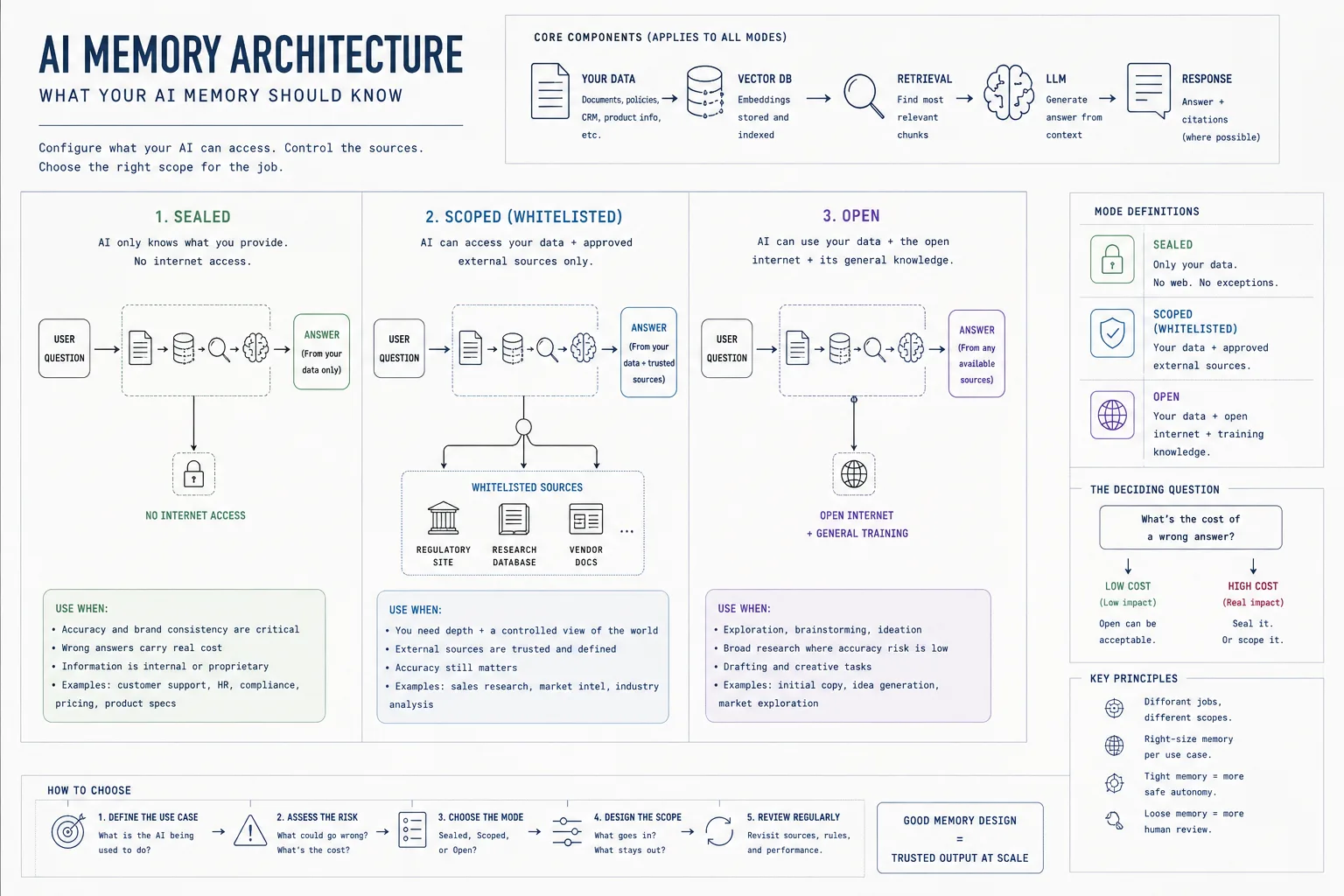
- AI memory has three modes: sealed (your data only), scoped (your data plus whitelisted external sources), and open (your data plus the internet and general training).
- Most AI tools default to open. Most businesses don't realise that is a choice they are making.
- Sealed is right when a wrong or off-brand answer damages trust. Whitelisted is the practical middle for most business AI. Open is for exploration and brainstorming.
- The deciding question is "what's the cost of a wrong answer?" Low cost: open is fine. Real cost: seal it or scope it.
- Decide memory per use case, not once across the business. Tight memory enables autonomy. Loose memory forces ongoing human review.
The three modes of AI memory
Practically, an AI's memory can be configured in three ways.
Sealed. The AI only knows what you've put in front of it. Your documents, your policies, your product information, your CRM data. Nothing else. It does not browse the web. It does not draw on general internet knowledge. It answers from your material or admits it can't.
Scoped with a whitelist. Core memory sits in your data, but the AI is also allowed to reach out to specific, trusted external sources. Your industry's regulatory body. A particular research database. A vendor's documentation site. Nothing beyond that list.
Open. The AI can access the open internet, its general training knowledge, and whatever you've given it. Fast, flexible, powerful, with all the unpredictability that comes with the open web.
Most AI tools default to open. Most businesses don't realise that's a choice they're making.
When sealed is the right answer
Sealed AI is the right answer whenever a wrong or off-brand response would damage trust.
Customer-facing bots. Internal HR assistants. Compliance lookups. Pricing queries. Product spec questions. Anywhere an answer needs to reflect what your business actually says, not the average of what every business in your industry happens to say online.
A sealed customer support assistant cannot tell a customer what a competitor's blog claims about returns policy. It cannot quote outdated employment law. It cannot recommend a workflow that contradicts how your team actually operates. Because it does not know any of that. It only knows what you've given it.
The trade-off is range. A sealed AI is brilliant inside its lane and useless outside of it. That's usually the point. You don't want your customer service bot doing freelance research. You want it answering on-brand, every time, from material you control.
When whitelisted earns its place
Whitelisted memory is the practical middle for most business AI, particularly anything sales or research adjacent.
A sales assistant that knows your products, your CRM, and your industry's research firm. A research analyst that can pull from your internal data and a curated set of journals. A market intelligence tool grounded in your strategy docs and a defined list of news sources.
You get the depth of scoped memory plus a controlled window onto the world. Your AI isn't blind, but it isn't grazing the entire internet either. The sources you've whitelisted are the ones you've already decided you trust.
Whitelisted memory takes more design work upfront. Someone has to decide what gets included, how it's weighted, and how often the list gets reviewed. That work pays off for years and gets you most of the value of an open setup with most of the safety of a sealed one.
When open is the right answer
Open memory genuinely helps for exploration, brainstorming, and broad research. Drafting initial copy. Scanning a market you don't know well. Generating ideas where the lack of constraint is the point.
It's the wrong answer for anything where consistency, accuracy, or brand voice matters. The open web does not know your business, does not share your standards, and will happily mix expert advice with someone's badly written hot take from 2019.
The mistake is treating open as the default for everything. It's a tool with a specific job. Use it for that job.
The question that decides
When you're choosing what an AI should know, the question that cuts through is this: what's the cost of a wrong answer?
If the cost is low, an off-target idea in a brainstorm, a slightly generic suggestion, a draft that needs editing, then open is fine. If the cost is real, a customer misled, a compliance line crossed, advice given that contradicts how your business operates, then it needs to be sealed.
Most businesses make this decision once, by accident, when they pick a tool. Then they live with it for years. The better path is to decide it per use case. Different jobs, different scopes. Your customer support AI does not need the same memory as your research AI, and giving them both the same setup is how you end up with one that's too loose and another that's too tight.
Where this connects to the rest of your AI
AI memory is not a side question. It's the foundation of every other decision about how your AI behaves.
A well-scoped AI can be trusted to run parts of your operation without a human checking every output. A poorly scoped AI needs constant supervision because nobody knows what it might say next. The first scales. The second does not.
This is also where humans-in-the-loop decisions get made. Tight memory means more autonomy can be safely handed over. Loose memory means more human review at every touchpoint, which is fine if that's the design, but expensive if it isn't.
If you're building anything more serious than a casual experiment, the memory question deserves real time at the start. It's the cheapest decision to get right early and the most expensive to fix later.

Doriel Alie
Doriel is the founder of Operational AI Systems, an AI consultancy and software development agency in Milton Keynes. More about Doriel.
Trending
Related post
Expand your knowledge with these hand-picked posts.

AI Trade-offs Nobody Warns You About
What manual processes catch that nobody writes down, what AI removes, and how to design those checks back in before quality slips. The honest audit before you automate.

AI Architecture That Reaches Production
Sync vs async, queues, retry logic, state handling, and the architectural choices that decide whether your AI scales or collapses under real load.
System Status