
What could your business earn next year that it could not earn last year, now AI is in the workflow?
Where AI Makes Money
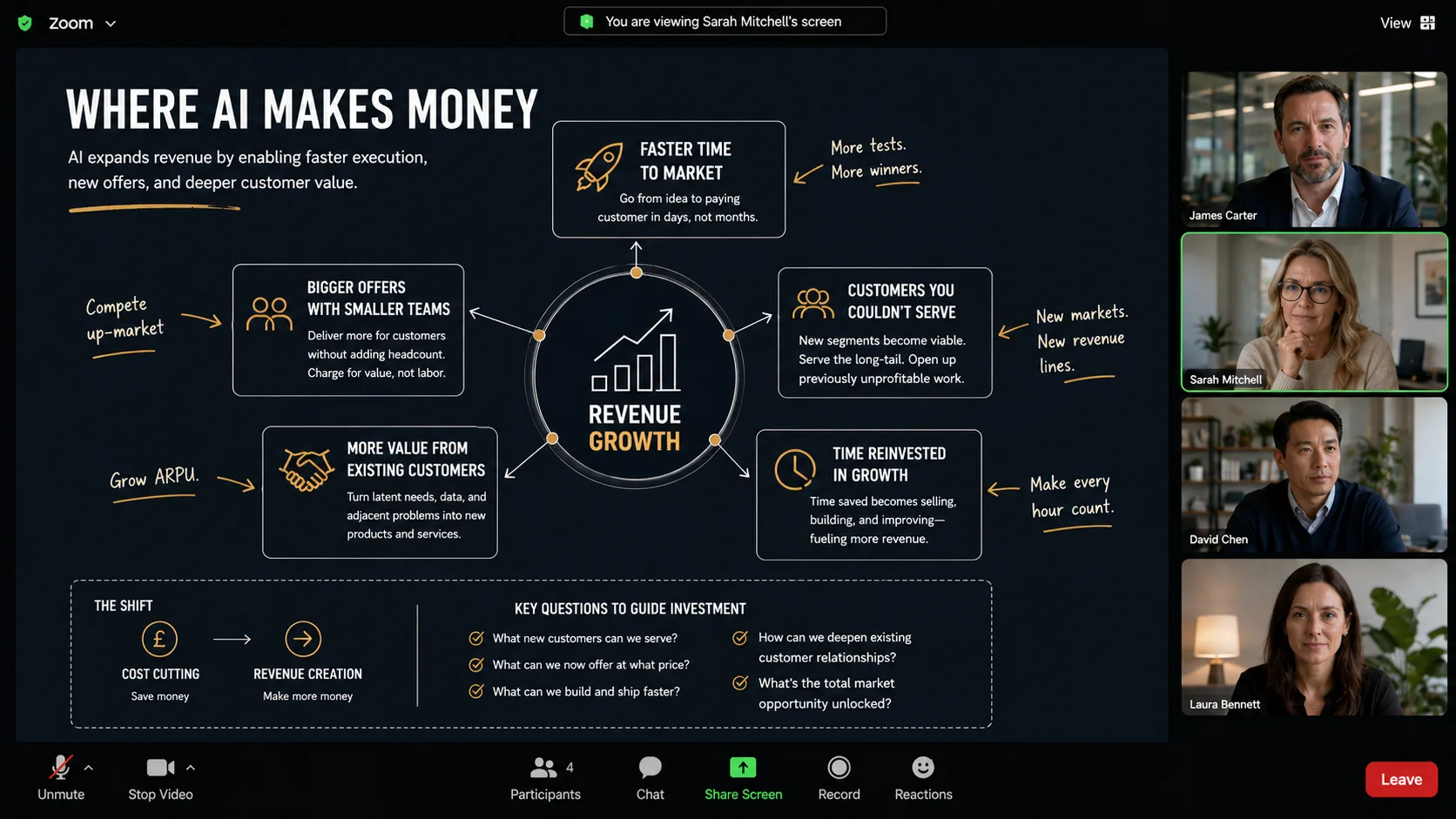
Most writing about AI for business is about saving money. Cutting costs. Reducing headcount. Making operations cheaper. All real, all worth knowing about. Also incomplete.
The conversation almost nobody is having is what AI does to the revenue side. What gets earned, not just what gets saved. That's the interesting half, and for most businesses, it's where the bigger numbers actually are.
This piece is about where AI makes money, not where it saves it. The revenue shifts that change what your business is capable of earning, and what that means for how you think about investing in AI in the first place.
Key Takeaways
- Cost-cutting is half the story. The revenue side is where the bigger numbers usually sit.
- AI collapses the time from idea to paying customer, multiplying how many shots on goal a business can take in a year.
- Small teams can now deliver large-scope work, breaking the old link between team size and price.
- Customers you couldn't economically serve become viable when AI absorbs the margin-eating work.
- The compound effect is what AI frees you up to do, not what it stops you doing. Revenue investment decisions look different from cost-saving ones.
The reframe
Money is the blood of a business. Every decision your business makes either earns it, protects it, or buys back time you can spend earning more of it.
When AI is framed as a cost-cutting tool, the reasoning is straightforward. You spend X on this work, AI does it for less, you save the difference. That maths is real and worth doing. It's also a small fraction of what AI actually does to a P&L.
The bigger question is what your business can earn now that it couldn't earn last year, because AI has changed what's possible to deliver, who's possible to serve, and how fast you can move from idea to paying customer. That's a different conversation. It's the one we're going to have here.
From idea to customer in days
Until very recently, the journey from "I have an idea" to "a customer is paying me for it" took months. You scoped, designed, built, tested, refined, marketed, sold. Even a lean version of that timeline ran into quarters.
That timeline is collapsing. A concept can be in front of paying customers in days, sometimes hours. Not because the work is sloppier, but because the slow parts (drafting, designing, building, writing, configuring) are now fast.
What this changes is the economics of trying things. If launching takes two days instead of two months, you can launch ten things this year instead of two. You can validate ideas with real customers instead of debating them in meetings. You can kill the bad ones quickly and double down on the ones that work.
Revenue follows from how many shots on goal a business can take. AI multiplies that number. The businesses we see growing fastest right now aren't necessarily building better products. They're testing more ideas, faster, in front of real customers, and scaling the ones that hit.
Smaller teams, bigger offers
A business of three people can now offer what used to take fifteen.
That sounds like a cost statement. It's actually a revenue statement. The three-person business doesn't just have lower payroll. It can credibly compete for work that previously required a fifteen-person firm, with the operational lift of a small team and the output of a large one.
What this does to pricing is interesting. The old logic was that scope drove team size and team size drove price. AI breaks that link. A small team can deliver large-scope work, which means it can charge for the value of the work, not the cost of the labour.
The businesses figuring this out early are doing things their competitors can't easily replicate. Bigger projects. Higher prices per unit. More retainer-style relationships where the value is in the outcome, not the headcount. The numbers come out very differently from a pure cost-cutting frame.
Customers you couldn't afford to serve
Every business has a list of customers, projects, or segments that don't quite work economically. The unit economics are too tight. The customer is too small. The project is too custom. The work doesn't scale. So those customers don't get served.
AI changes which of those customers are economically viable. Work that was too expensive to deliver at the price the customer would pay starts becoming deliverable at that price, because AI absorbs the parts that were eating the margin.
Whole new revenue lines open up here. Long-tail customers you used to refuse politely. Smaller engagements you used to bundle as favours. Markets you ignored because the average deal size was too small to cover the cost of serving them. With AI in the workflow, the maths changes, and a lot of those become genuinely worth doing.
This is the part of the AI revenue story most businesses underestimate. They think about doing existing work cheaper. They don't think about doing previously unviable work at all. The second category is often bigger.
Hidden revenue in existing relationships
Your existing customers are buying a fraction of what they could be buying from you. They have problems you could solve that you don't currently offer to solve. They have data you have access to that you've never turned into a product. They have related needs you've never quite been resourced to address.
AI changes which of those latent revenue lines become reachable. Capabilities that used to require building out a new team can be built into your existing offer. Data you already have can be turned into reports, recommendations, or services you can sell. Relationships that used to support one product can support three.
We've watched businesses double their revenue per customer in a year just by being able to deliver things they could always have delivered, but couldn't previously afford to deliver. The customer was always there. The capability was always nearly there. AI closed the gap.
The compound effect
Every hour AI takes back is an hour your business can spend on something else. The question is what that something else actually is.
If the saved hour goes into more customer work, you're directly increasing revenue. If it goes into business development, you're indirectly increasing revenue. If it goes into building the next thing, you're investing in future revenue. If it goes into administrative work that doesn't earn, you're saving cost only. The choice is yours.
The businesses that get the most out of AI are deliberate about where the time goes. The businesses that don't, fill the time back up with the same kinds of work AI just freed up from somewhere else, and wonder why the revenue picture hasn't moved much.
This is the compound effect that makes AI worth the investment in revenue terms. Not the saved cost on the work it took over. The earned revenue from the work it freed someone up to do.
How to think about AI investment
If revenue rather than cost is the right lens, AI investment decisions look different.
The question stops being "how much will this save us?" and starts being "what does this make possible that wasn't possible before?" That's a harder question to answer with a spreadsheet. It's also where the bigger numbers are.
A few specific reframes worth running:
What customers could we credibly serve now that we couldn't last year, and how big is that market?
What can we charge for, at what price, that we couldn't have offered in a viable form before?
What new things can we build and ship in the time AI takes back, and what's that worth?
What existing customers could we deepen the relationship with, given new capabilities we can now offer?
Numbers come out of these questions. Not as cleanly as a cost-saving model. But typically larger, and more interesting.
A note on the cost side
None of this is to say cost-cutting doesn't matter. It does. Most businesses have admin and operations work that should be automated, and the savings are real. We've written about that elsewhere.
The point of this piece is balance. The cost story has been told repeatedly. The revenue story is bigger, less told, and where most of the upside is sitting. If your AI conversation is mostly about saving money, you're having the smaller half of the conversation.
Money is the blood of the business. AI is one of the few things that can change how much of it your business is capable of generating, not just how much of it goes back into operations. That's the half worth the focus.

Doriel Alie
Doriel is the founder of Operational AI Systems, an AI consultancy and software development agency in Milton Keynes. More about Doriel.
Trending
Related post
Expand your knowledge with these hand-picked posts.

AI Trade-offs Nobody Warns You About
What manual processes catch that nobody writes down, what AI removes, and how to design those checks back in before quality slips. The honest audit before you automate.

AI Architecture That Reaches Production
Sync vs async, queues, retry logic, state handling, and the architectural choices that decide whether your AI scales or collapses under real load.
System Status