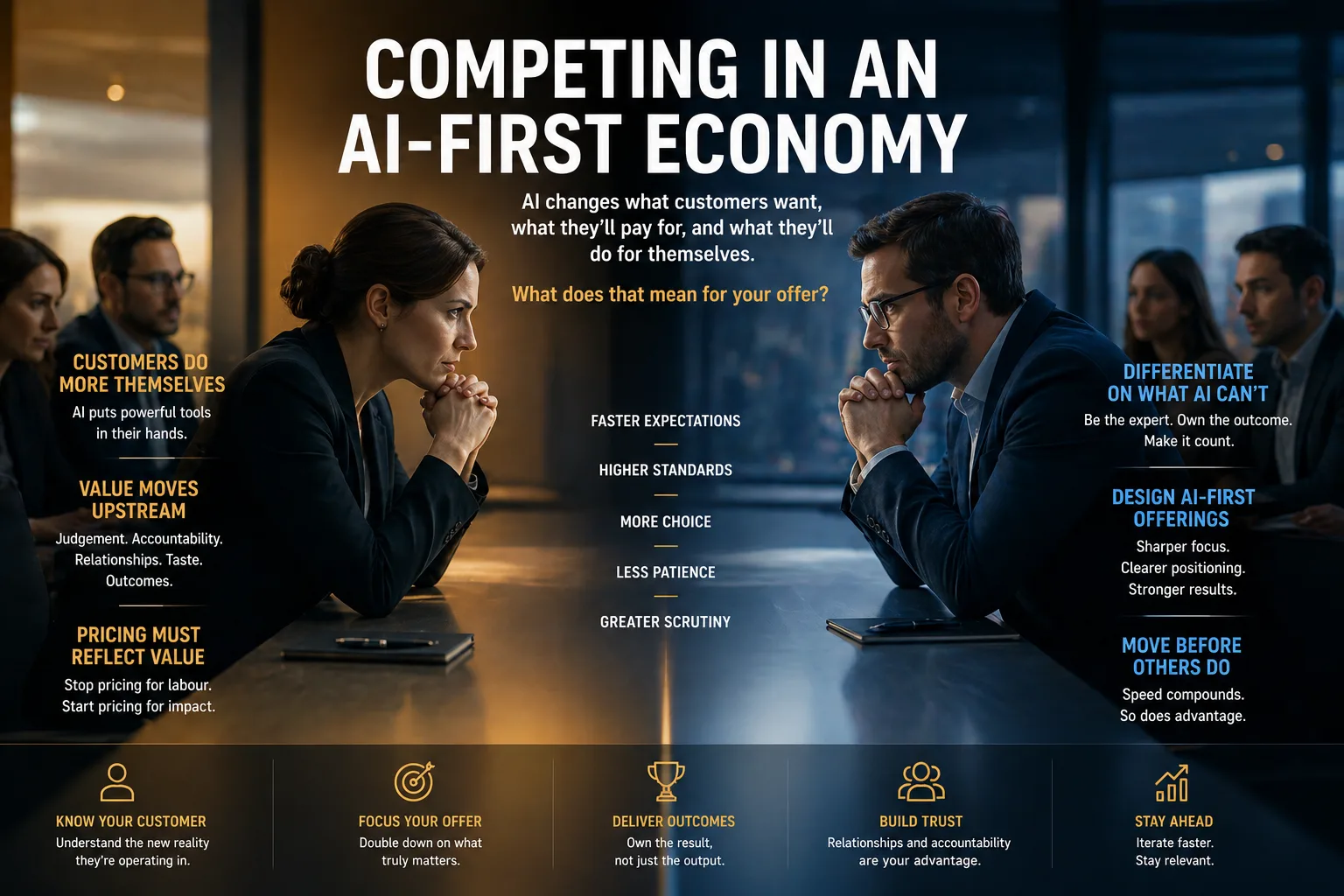
What part of your offer could a customer now do with AI in an afternoon?
Competing in an AI-First Economy
Most pricing decks were built before customers could do half the work themselves. Most positioning was written when expert knowledge was a moat. Most service tiers were drawn up when labour cost roughly tracked the value being delivered.
None of those assumptions are stable any more. The AI-first economy is already underway, and the businesses that haven't reckoned with it are about to find out the hard way.
This piece is about what changes when AI is in your customer's hands and your competitor's hands at the same time, and what to do about it before conversions start sliding for reasons you can't quite name.
Key Takeaways
- AI is already in your customers' hands. The first move is walking your offer line by line and marking what they could now do themselves in an afternoon.
- Value moves upstream toward judgement, accountability, relationships, taste, and owned outcomes. AI does not take that ground.
- Most service businesses are still pricing for labour AI now does free. The shift is narrower offer, higher value per unit.
- Customer expectations have already changed: faster turnaround, more personalisation, more in-the-loop iteration, less patience for generic expertise framing.
- Capability is moving every six to eight weeks. Start the audit now even if the redesign takes a while; the cost of waiting compounds.
What customers can now do themselves
Start with the most uncomfortable question. What part of your offer could a customer now do with AI in an afternoon?
Drafting a contract. Producing a marketing brief. Writing a job spec. Building a financial model. Designing a logo. Researching a market. Generating a project plan. Writing a website. None of these are theoretical. Customers are doing all of them right now, often with mixed results, often well enough that they don't feel the need to commission someone for them any more.
That doesn't mean those services are dead. It means they're not what people will pay you for at the price you used to charge.
The first move in an AI-first economy is to walk through your own offer with this question on your shoulder: which parts of this is the customer about to do without us?
Where the value moves
The good news, and there is plenty of it, is that AI doesn't replace everything. It replaces a specific set of things: the parts of work that produce output to a known specification. The parts of work it doesn't touch are the ones most professionals undervalue when they price themselves.
Judgement. Knowing which option is the right one for this specific situation, this specific company, this specific moment, when reasonable people could choose differently.
Accountability. Putting your name to a recommendation and standing behind it when something goes wrong. AI does not sign anything.
Relationships. Knowing the people in the room, what they actually mean when they say something, what they're not saying, what they need from you that they haven't asked for.
Taste. Choosing one direction out of ten plausible directions because something about it is right. Not justifiable yet, just right. Taste is the thing AI is worst at and the thing senior practitioners are best at.
Outcomes. Owning the result, not just the deliverable. This is the largest unclaimed value pool in most professional services right now.
These are the high-ground positions. AI doesn't take them. It does, however, free people from the lower-ground work that used to subsidise them, which means the high-ground positions are about to get more valuable and more crowded at the same time.
The pricing trap
A lot of professional services businesses are still pricing for the labour AI does free.
Hourly rates that include drafting time. Project fees that bundle research the customer could now do in twenty minutes. Retainers that cover routine work with no marginal cost any more. Every line of those quotes is a bet that the customer either can't or won't reach for the AI alternative.
That bet held up until about eighteen months ago. It does not hold up now, and it gets weaker every quarter.
The repricing question isn't "should we charge less?" It's "what are we actually being paid for, once we strip out the parts AI now does?" The answer is usually narrower than the current pitch deck suggests, and worth more per hour than the current pricing assumes.
Narrower offer, higher value per unit. That's the shape most professional services need to move toward.
What AI-first actually means
A lot of businesses are saying they're AI-first when what they mean is "we have a chatbot now." That's not what AI-first means.
AI-first is a design choice about how the business is built. It assumes that AI exists in everyone's hands, including your customers' and your competitors'. It bakes that assumption into pricing, positioning, service design, product design, and team structure.
An AI-first business asks, of every line of work it does, whether AI should be doing it, drafting it, or staying out of it entirely. It asks the same question of every offer it sells. It asks the same question of every internal process. The answers shape the business.
That is different from "using AI." Using AI is a tactic. Being AI-first is a strategic posture about what kind of business you're running.
What's changing on the customer side
It's worth being explicit about what AI does to customer expectations, because this is where most of the surprise lands.
Customers expect faster turnaround. They know what AI can do, so a five-day timeline for something AI could draft in five minutes feels suspect, even if the five days include real expert work the AI couldn't do. The pitch needs to make that distinction visible.
They expect more personalisation. Generic outputs are now produced in seconds. If your service feels generic, it feels lazy by comparison, even if it isn't.
They expect to be in the loop. Customers using AI themselves know how iterative it is. They want to see drafts, give input, course-correct. The "we'll come back in three weeks with the final" model is starting to feel old.
They are more sceptical of expertise framing. "We've been doing this for twenty years" carries less weight when an AI can produce a credible first draft of most things in twenty seconds. Experience still matters, but the way you demonstrate it has to update.
These shifts are quiet. They don't show up in any single conversation. They show up in conversion rates, in the way clients negotiate scope, and in which competitors start winning that didn't used to.
Speed matters more than usual
Markets usually move slowly enough that you can read the change, debate it, and respond next year. This one isn't moving like that.
The capability of widely available AI is changing every six to eight weeks. What customers can do this quarter, they couldn't do last quarter. What competitors are offering this month would have been unviable last year. The repositioning that would have been a five-year project in a normal cycle is a six-to-twelve-month project in this one.
That doesn't mean acting rashly. It means starting the audit now, even if the redesign takes a while. The cost of waiting compounds. So does the value of moving early on the things you can already see clearly.
What to actually do this quarter
If this is the first proper conversation you've had about your market in the AI-first economy, three moves are worth more than any framework.
The first: walk your offer line by line and mark anything a customer could now do with AI. Be honest. Don't grade yourself generously.
The second: name the things you do that AI genuinely can't, in language a customer would recognise. Not "expertise." Specific things. Specific judgement calls, specific relationships, specific accountability, specific outcomes you've owned.
The third: look at your pricing. Decide what you're really being paid for, given the first two answers. Then decide whether your prices reflect that or are still anchored to the labour you used to bill for.
That's enough to start. It is also more than most of your competitors have done, which is the whole point.
What doesn't change
For all the change in markets right now, some things matter more, not less.
Customers still want to feel understood. They still want to deal with people who know their context, take responsibility, and bring something to the table that isn't just output. The difference is that they have less patience for paying for output they could produce themselves, and more willingness to pay for the things they can't.
The businesses that come through the next three years strongest aren't the ones that adopt AI fastest. They are the ones that read what AI does to their market clearly, then move their offer to the ground AI can't take. That ground is more valuable than it has been in a generation. Most of it is still unclaimed.

Doriel Alie
Doriel is the founder of Operational AI Systems, an AI consultancy and software development agency in Milton Keynes. More about Doriel.
Trending
Related post
Expand your knowledge with these hand-picked posts.

AI Trade-offs Nobody Warns You About
What manual processes catch that nobody writes down, what AI removes, and how to design those checks back in before quality slips. The honest audit before you automate.

AI Architecture That Reaches Production
Sync vs async, queues, retry logic, state handling, and the architectural choices that decide whether your AI scales or collapses under real load.
System Status