Where is your real bottleneck right now: not enough hours, too much admin, or a product that has plateaued?
Three Paths for AI Adoption
The case studies you read about AI adoption are mostly written for a business you don't run. The teams have hundreds of engineers. The budgets have eight figures. The transformation roadmaps stretch over years. None of it scales down to a business of fifteen, fifty, or two hundred people.
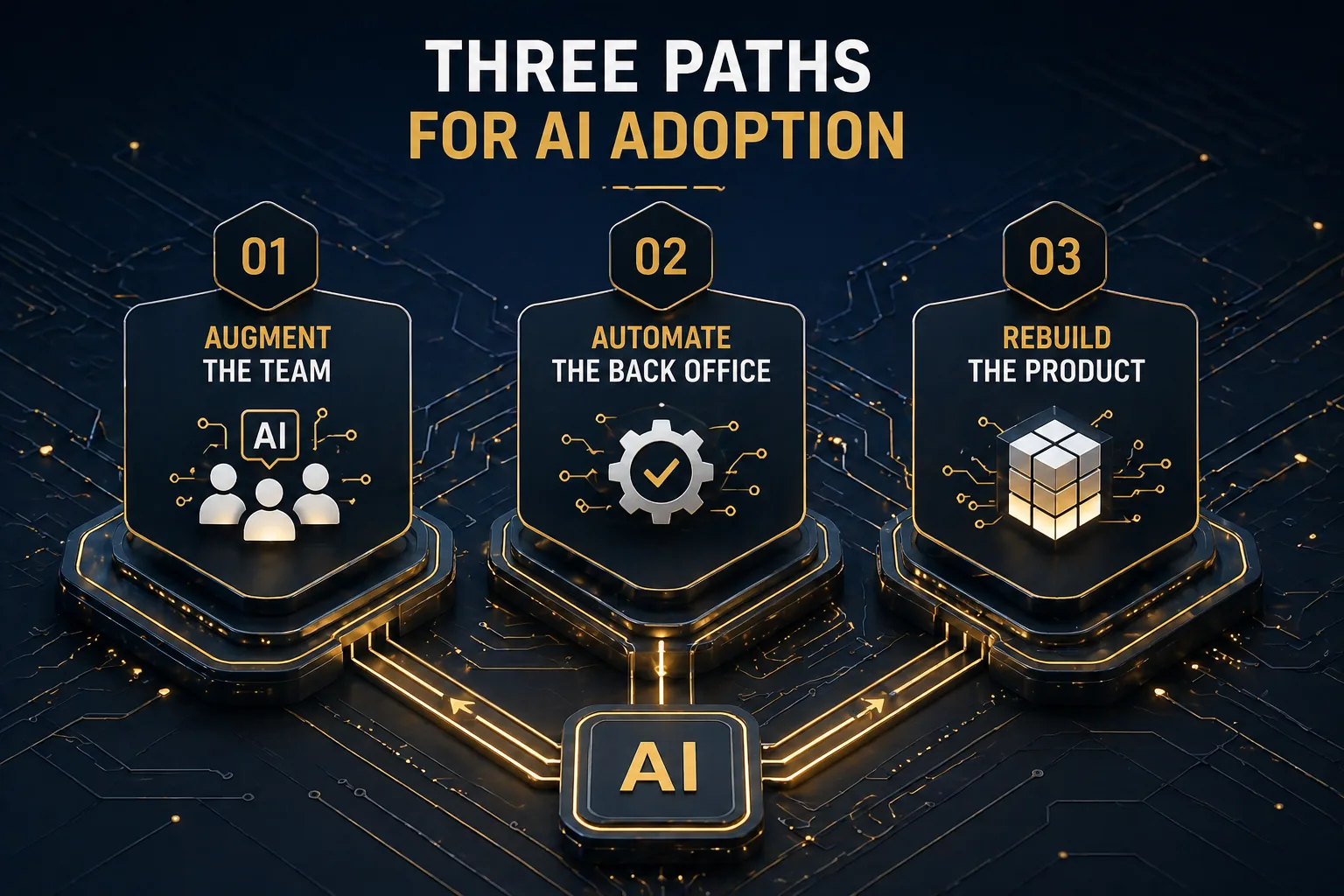
What actually fits a normal-sized business is one of three paths. Each is real. Each has businesses it's right for and businesses it would be wrong for. Each has signals that tell you, fairly clearly, which one is yours.
This piece is about picking the AI adoption path that fits your business now, not the path that fits the case study someone forwarded you.
Key Takeaways
- Augment the workforce: better AI tools in your team's hands so the slow parts of the job go fast. Results in weeks.
- Automate the back office: take repetitive, rules-based workflows off people's plates entirely. Results in months.
- Rebuild the product: fold AI into what you sell, changing what the product does or how customers interact with it. Results in quarters or years.
- Pick by bottleneck: not enough hours points to augmentation, too much admin to automation, plateaued product to rebuild.
- One path at a time, picked because it fits, beats running all three at once and finishing none.
Path one: augment the workforce
The first path is the simplest. You give your team better AI tools and you teach them to use them well.
This looks like a designer using AI for early visual exploration, then doing the polish themselves. A salesperson drafting follow-ups in seconds and personalising them in minutes. An analyst getting an AI to do the first cut of a report and editing the parts that need real judgement. A junior lawyer drafting clause suggestions for a senior to review. Engineering teams using AI coding assistants in their daily work.
The work doesn't get automated. The people doing the work get sharper. Output per person goes up, not because anyone is grinding harder, but because the slow parts of their job are now fast.
This path is right for businesses where the work genuinely needs human judgement, taste, or relationships, but the time spent on the routine pieces is what's holding output back. Professional services. Creative agencies. Small consulting firms. Sales teams. Engineering teams. Anywhere the bottleneck is talented people not having enough hours.
The signals that this is your path: your team is busy, you can't easily hire faster, you have repeat administrative work bundled into roles that should be doing higher-value things, and the work itself is varied enough that full automation would lose what customers actually come to you for.
The risk is rolling it out badly. Tools dropped on people without training, without a clear shape for how they fit into the work, without follow-up, mostly fail. Augmentation is more about adoption and habit than about technology.
Path two: automate the back office
The second path is to let AI take entire workflows off people's plates rather than just speeding individuals up.
This looks like invoice processing handled end to end without a person involved. Customer service tickets categorised, prioritised, and partially answered before anyone touches them. Reports generated and sent automatically, with humans only seeing the exceptions. Data flowing between systems being cleaned and reconciled by AI. New starter onboarding automated through documents and forms. Internal helpdesk questions answered by an AI sitting on top of company policies.
The work doesn't just get faster. It gets removed from the daily list. People who used to spend two days a month on repetitive admin spend zero days a month on it.
This path is right for businesses with high volumes of repeatable, rules-based work that's currently being done manually because the previous generation of automation tools couldn't handle it. Operations-heavy businesses. E-commerce. Financial services back office. Property management. Hospitality groups. Anywhere the back office has grown faster than headcount can keep up.
The signals: you have processes that happen the same way thousands of times. The exceptions are well understood. The work is currently being done by humans because nobody got round to automating it, not because it genuinely needs them. You're hiring for roles that mostly process things rather than think about things.
The risk is automating a bad process faster, which is its own conversation. Audit the workflow before you hand it to AI. Otherwise you're just industrialising your inefficiencies.
Path three: rebuild the product
The third path is the most ambitious. You take AI capabilities and you fold them into what you sell, changing what your product can do or how customers interact with it.
This looks like a software product that adds an AI assistant inside it for users. A consultancy that turns part of its methodology into an AI-powered tool customers can use directly. A media business that personalises content per reader using AI. A service business that delivers part of the service through an AI interface. A retail business that adds AI-driven recommendations or shopping assistants. A training business that turns recorded expertise into a conversational tutor.
The work changes shape. Some of what you used to deliver as a service becomes something the customer interacts with directly through your product. Some of what was hands-on becomes self-serve at higher quality. New offerings become possible that weren't viable before.
This path is right for businesses that already have a product or service with reach, a moat, and customer trust, where AI can extend what they offer or change the unit economics of who they can serve. Software companies. Media businesses with an audience. Consultancies with codified IP. Service businesses with strong customer relationships.
The signals: you have customers who would pay for more, but you can't currently afford to deliver more. You have expertise inside the business that lives in people's heads and could be productised. You compete in a market where the offer is being commoditised by AI and the response has to be a different kind of offer.
The risk is the most significant of the three. Product rebuilds take months, sometimes years. They burn cash. They can fail. The businesses that should be on this path are usually the ones that have done at least one of the other two first.
How to choose
Most businesses can identify their path with three honest answers.
Where is your bottleneck right now? Talented people not having enough hours, repetitive work eating the company, or a product that has plateaued and needs a step change? The first answer points to augmentation, the second to back-office automation, the third to product rebuild.
What's your appetite for risk and time? Augmenting the workforce shows results in weeks. Automating the back office shows results in months. Rebuilding the product shows results in quarters or years. Pick the path you can sustain.
What have you already done? Most businesses jumping into a product rebuild without having mastered the simpler paths struggle. Most businesses stuck only on augmentation are leaving back-office wins on the table. The right next step depends on where you actually are, not where you'd like to be.
Doing more than one path
Many businesses end up doing all three over time. They start by augmenting individuals. Then they automate parts of the back office once they understand AI's strengths and limits. Then they rebuild the product when they have the operational maturity to support it.
The mistake is doing all three at once, before any of them have proven themselves. That's how AI budgets get spent without anything reaching production. One path at a time, picked because it fits where you are, gets results that fund the next one.
The case studies from large enterprises showing all three running simultaneously are misleading for smaller businesses. Those companies have the headcount to run parallel programmes. Most don't, and the right move is to pick the path that fits now, ship it, learn from it, and let it teach you which one fits next.
The path matters less than the commitment. A business that picks one path and runs it well is going to beat a business that hedges across all three and finishes none of them.

Doriel Alie
Doriel is the founder of Operational AI Systems, an AI consultancy and software development agency in Milton Keynes. More about Doriel.
Trending
Related post
Expand your knowledge with these hand-picked posts.

AI Trade-offs Nobody Warns You About
What manual processes catch that nobody writes down, what AI removes, and how to design those checks back in before quality slips. The honest audit before you automate.

AI Architecture That Reaches Production
Sync vs async, queues, retry logic, state handling, and the architectural choices that decide whether your AI scales or collapses under real load.
System Status