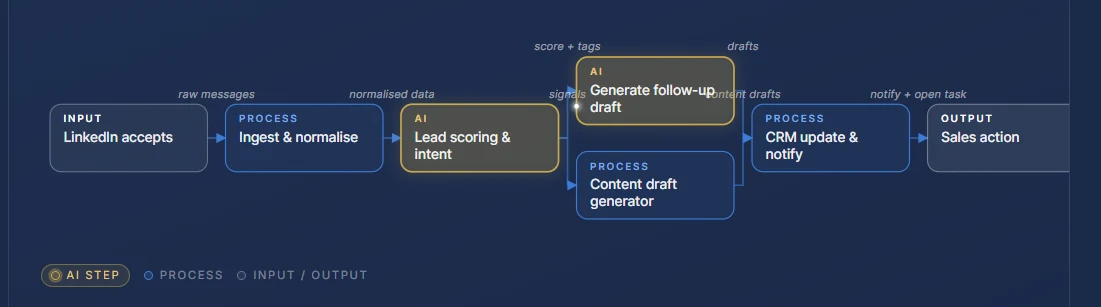
Advisory Toolkit for an Accountancy Practice Past MTD
A UK accountancy practice serving SME clients was watching Making Tax Digital eat its compliance revenue. Advisory was the natural pivot, but slow to deliver and trapped in the accountant's head. We built a phased, AI-assisted advisory toolkit that lets one accountant deliver consistent, scenario-led planning to a growing book of clients, and a roadmap that bends with the next round of MTD changes rather than freezing the practice into a position that will be wrong in eighteen months.
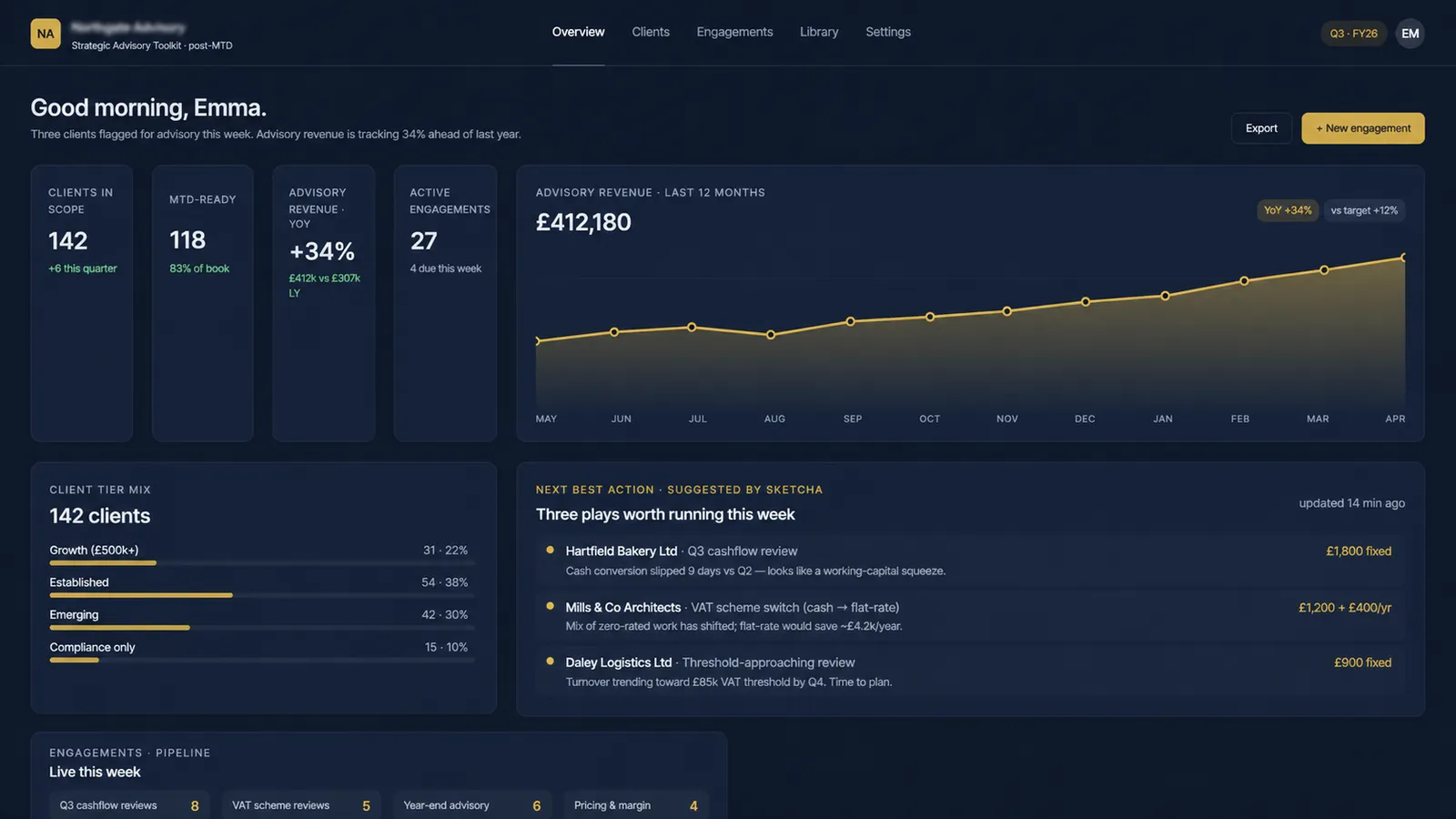
Partner overview dashboard
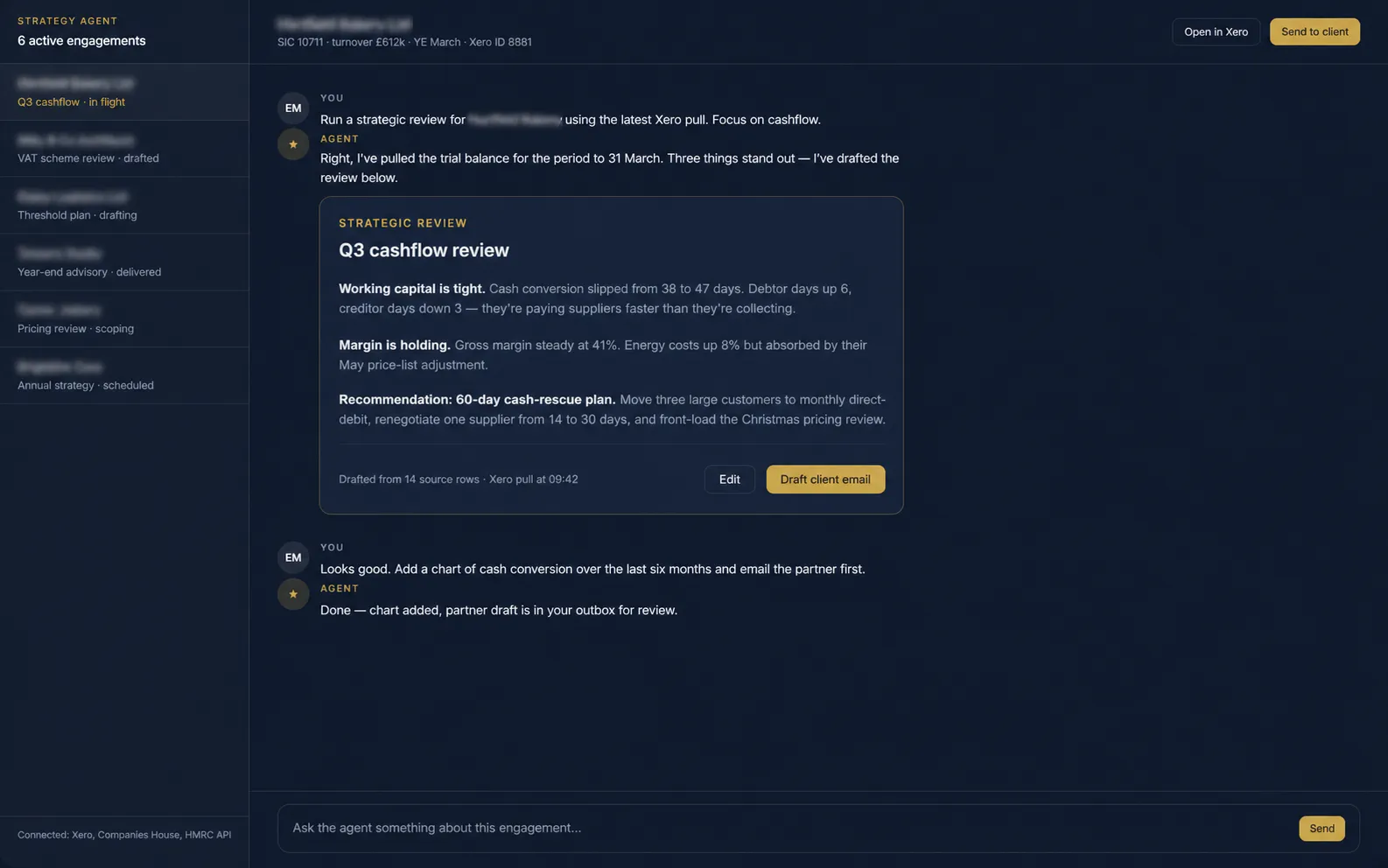
Agent drafting a Q3 cashflow review
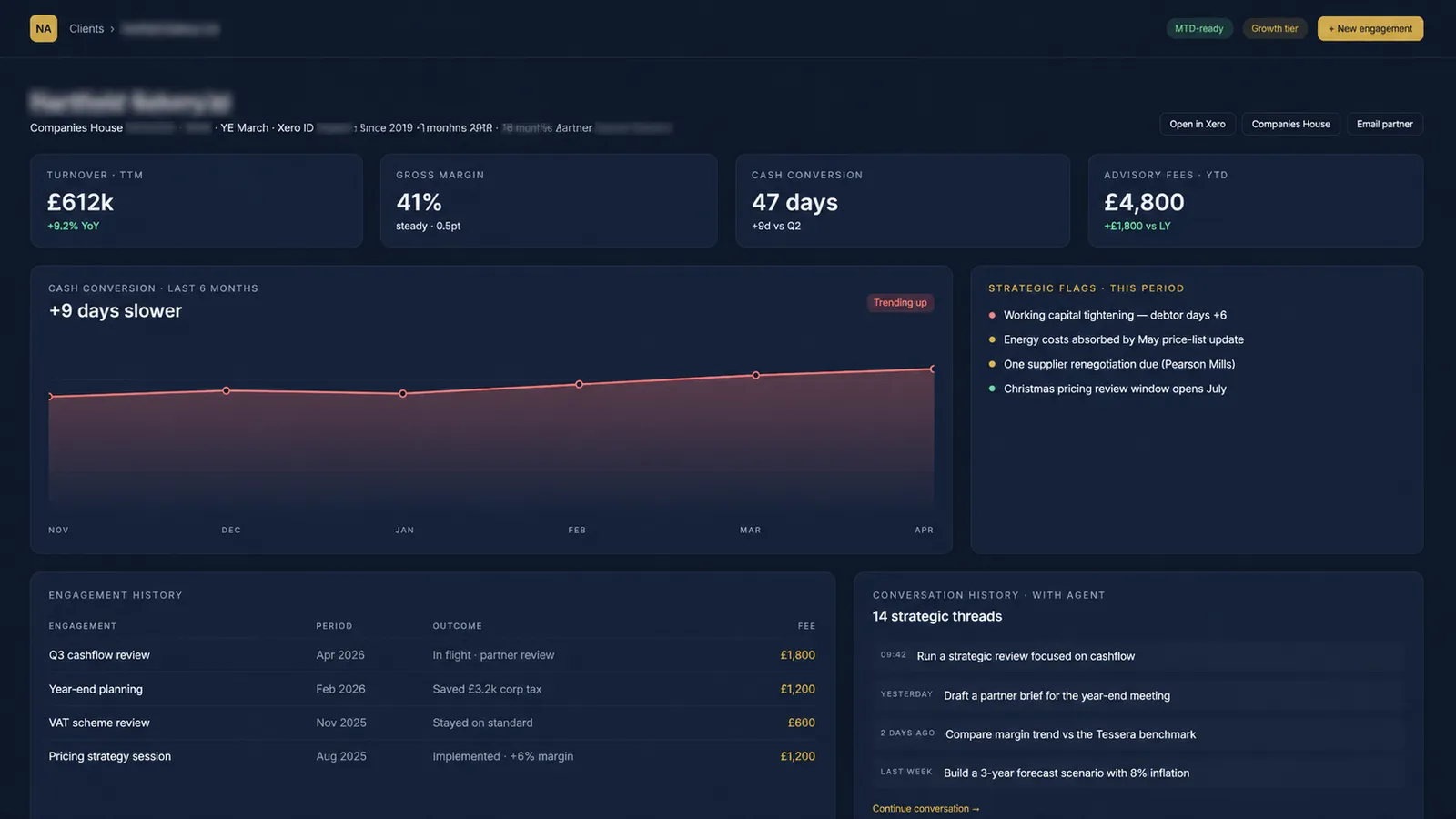
Client deep-dive
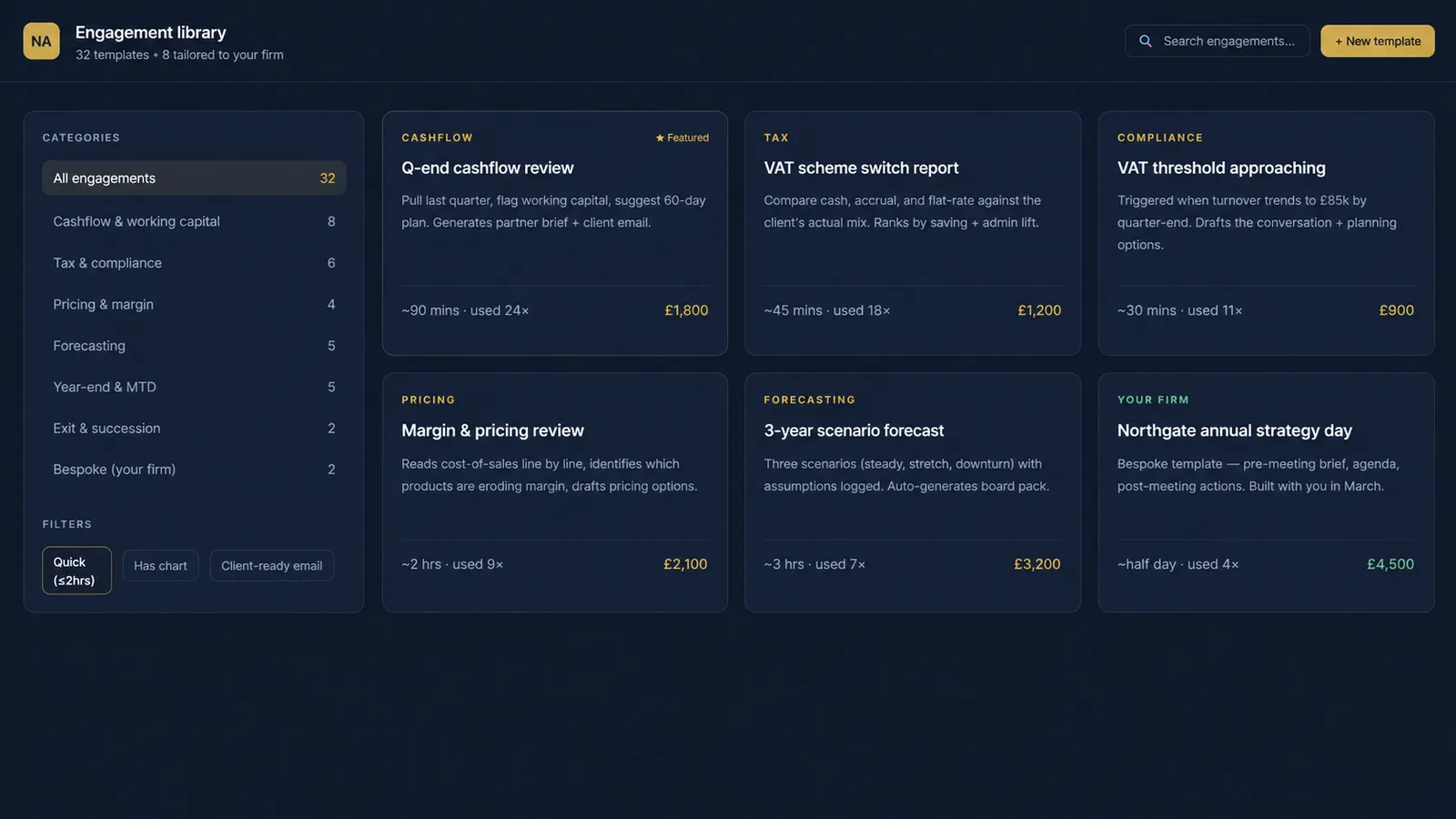
Engagement library · 32 templates
At a glance
- Industry
- UK accountancy practice serving SMEs
- Team size
- Small owner-led practice
- Mode
- Build, multi-phase, client-led roadmap
- Status
- Live and in active use
- Friction type
- Compliance revenue eroding under Making Tax Digital. Advisory work the natural pivot but slow to deliver and hard to scale. Strategy and planning insights trapped in the accountant's head. Lots of build ideas at risk of being attempted all at once.
- Tools
- Python, FastAPI, React, Google Cloud Run, Google Workspace (Docs, Sheets, Drive), Google Cloud Storage, OpenAI API, internal admin dashboard.
- AI patterns
- Scenario modelling with explainable outputs, plain-English explanation layer over technical recommendations, internal insight surfacing from captured client data, roadmap discipline (build the most valuable thing now, defer the rest).
The Client
A UK accountancy practice serving small and mid-sized businesses. Owner-led, lean team, long-standing client base. Strong commercial instincts and a head full of ideas about where the practice could go. Compliance work had been the engine of the practice for years. Making Tax Digital was changing that, and the owner could see it coming.
The Problem
On the surface: Making Tax Digital is reshaping what accountants get paid for. The compliance work that used to be the bulk of revenue is becoming faster, cheaper, and more automated. That's a win for clients. It's an existential challenge for any practice that has not moved its centre of gravity off compliance and into something else.
Underneath, the deeper costs:
- Advisory was already happening, just not visibly. Tax planning, business structure conversations, investment timing. Delivered in conversations, on the back of experience, never captured in a way the practice could lean on or scale.
- Each engagement took too long. Producing a scenario analysis meant building it from scratch in a spreadsheet every time. High value, slow to deliver, hard to charge for at the rate it deserved.
- Clients did not know what they were missing. Many came in for compliance and never got offered the advisory work they actually needed. Cross-sell happened in flashes, not consistently.
- Lots of build ideas, no clear order. The owner had at least a dozen tool ideas. Building them all at once was a fast route to shipping none of them well.
- The market is moving. Whatever got built had to bend with the next round of MTD changes, not freeze the practice into a position that would be wrong in eighteen months.
The practice did not need a tax engine. There are products for that. It needed a strategic advisory toolkit that let one accountant deliver consistent, high-quality planning work to a growing client base, and a process that picked the right tools to build first.
The Solution
A set of client-facing analytical tools embedded in the practice's website, with the accountant's expertise wrapped around them. Built in phases, with a hard prioritisation conversation in front of every phase: what is nice to have, what is essential right now, what is a roadmap item for later.
Most of the original ideas were good. Most were not the most valuable thing to build first. A real chunk of the early work was educational, helping the owner separate “this would be brilliant in two years” from “this would change the practice next quarter.” That conversation became part of how the practice now plans its own offer.
Phase one delivered three tools that did most of the work.
Tool 1
Client position capture
Structured input form on the practice website. Revenue, costs, structure, drawings, pension position, investment plans, household income mix. Designed to feel like a planning conversation, not a tax form. Captured to Google Sheets via a Python backend.
Tool 2
Scenario modelling
Accountant configures scenarios per client. Incorporate or stay sole trader. Dividends versus salary. Pre year-end pension contributions. Group structuring. Each scenario runs as a Python calculation against captured data with current HMRC rules encoded.
Tool 3
Plain-English explanations
An AI explanation layer translates each scenario into language the client can act on. The accountant reviews and edits before anything goes out. The AI accelerates the explaining; it does not replace the judgement.
What it deliberately is not:
- Not a self-serve robo-advisor. The accountant stays in the seat. Clients get insights, but the recommendation is always the accountant's, signed off by them.
- Not a full tax engine. That is a different product category. The job here is advisory, not compliance.
- Not everything at once. The roadmap is real and stretches across multiple phases. What got built first was what gave the practice the most leverage immediately.
Roadmap discipline. The roadmap is documented, scoped, and costed, and explicitly flexible. Whatever HMRC, the market, or the practice's own client base does next, the roadmap bends with it. Features that looked essential six months ago can drop down the list. Features that looked nice-to-have can become urgent. The build process treats this as a feature, not a bug.
AI step breakdown
Scenario explanation generation
- How it is used:
- Once a Python calculation produces the numbers, an AI layer translates the output into plain-English narrative for the client. Why it matters for them, what the assumptions were, what the trade-offs are.
- Autonomy:
- Drafting only. Accountant reviews and edits every explanation before it reaches the client. Never autonomous to the client.
- Uniquely good at:
- Producing the kind of clear, contextualised explanation a senior accountant would write for a client briefing, in seconds rather than the half-hour to write from scratch. Adjusts language and depth for the specific client.
Internal insight surfacing
- How it is used:
- When a client submits new data, an AI layer scans the position for opportunities, anomalies, and missed reliefs. Produces an internal brief flagging anything worth raising in the next conversation.
- Autonomy:
- Internal only. Surfaces to the accountant, never to the client directly. The accountant decides what is worth escalating and how to frame it.
- Uniquely good at:
- Catching the non-obvious connections. Pension annual allowance not being used. A capital allowance opportunity in a recent purchase. An income mix that could be restructured.
The stack
- Backend: Python, FastAPI for the API layer.
- Frontend: React for client-facing tools embedded in the practice's website. Internal admin dashboard also React.
- Calculations: Python with HMRC rules encoded, version-controlled so changes can be reviewed, tested, and rolled back.
- AI: OpenAI API for explanation generation and internal insight surfacing.
- Data and documents: Google Workspace. Sheets for structured client data, Docs for client-facing reports, Drive for storage and sharing.
- Storage: Google Cloud Storage for backups and document archive.
- Hosting: Google Cloud Run. Each tool is its own service, which keeps the build modular and the roadmap easy to extend.
- Auth: Google Workspace SSO for the practice; lightweight client portal auth for clients submitting via the website.
The outcome
- Time per advisory engagement materially reduced. Preparation that used to take half a day now runs as 20–30 minutes of accountant review and personalisation on top of pre-prepared scenario outputs.
- Consistency of advisory. Every client gets a structured analysis, not just the ones the accountant happens to think of. Cross-sell opportunities surface automatically.
- Client conversations shifted from compliance-only to strategy-led. Clients arrive with scenario outputs already in hand and want to talk about what to do, not what the numbers are.
- Practice positioning moved. From “we do your tax” to “we help you plan your business.” The conversation MTD is forcing every accountant to have, backed by tools.
- Roadmap discipline. Features shipped in priority order. Several original ideas deliberately not built yet, queued ready to bend when the market shifts.
- Educational outcome on the practice side. The build process itself sharpened the owner's view of what to offer, what to charge for, and how to explain it.
- Status: Live and in active use. Phased roadmap scoped, costed, and queued.
Lessons
When a client has lots of ideas, the temptation is to build them all. The job is the opposite. Pick the few that move the most weight, build those well, and queue the rest behind a roadmap that bends with the market. MTD is reshaping accountancy faster than most practices it is reshaping. The roadmap has to be just as ready to swing.
Got an idea like this in your own business?
Sketcha is a quick, no-pressure way to talk it through. Tell me where things are sticking and you'll walk away with a sketch of how a system could look, including a flow diagram of the AI bits.