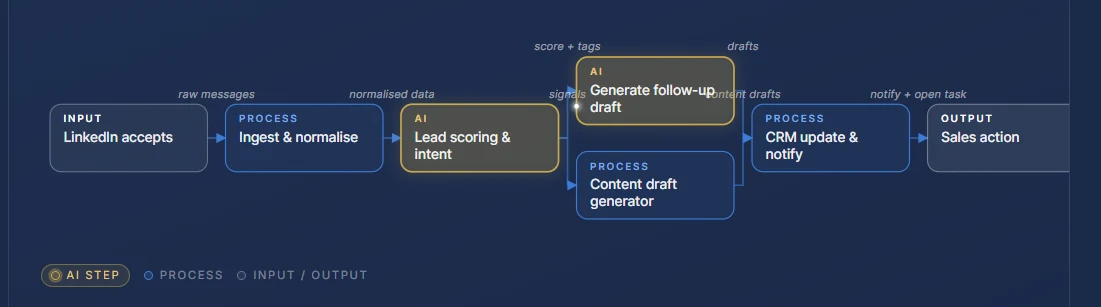
Competitor Radar
A multi-product platform vendor in UK adult social care needed a weekly read on a moving market, regulator announcements, competitor product launches, funding rounds, hiring patterns, review-site sentiment. The manual sweep across 30+ sources was inconsistent, slow, and rarely the same shape twice. We built a single-command agentic pipeline: seven specialised agents that run in sequence, capture and dedupe signals, and produce a leadership briefing of the 10 to 15 items that actually matter.
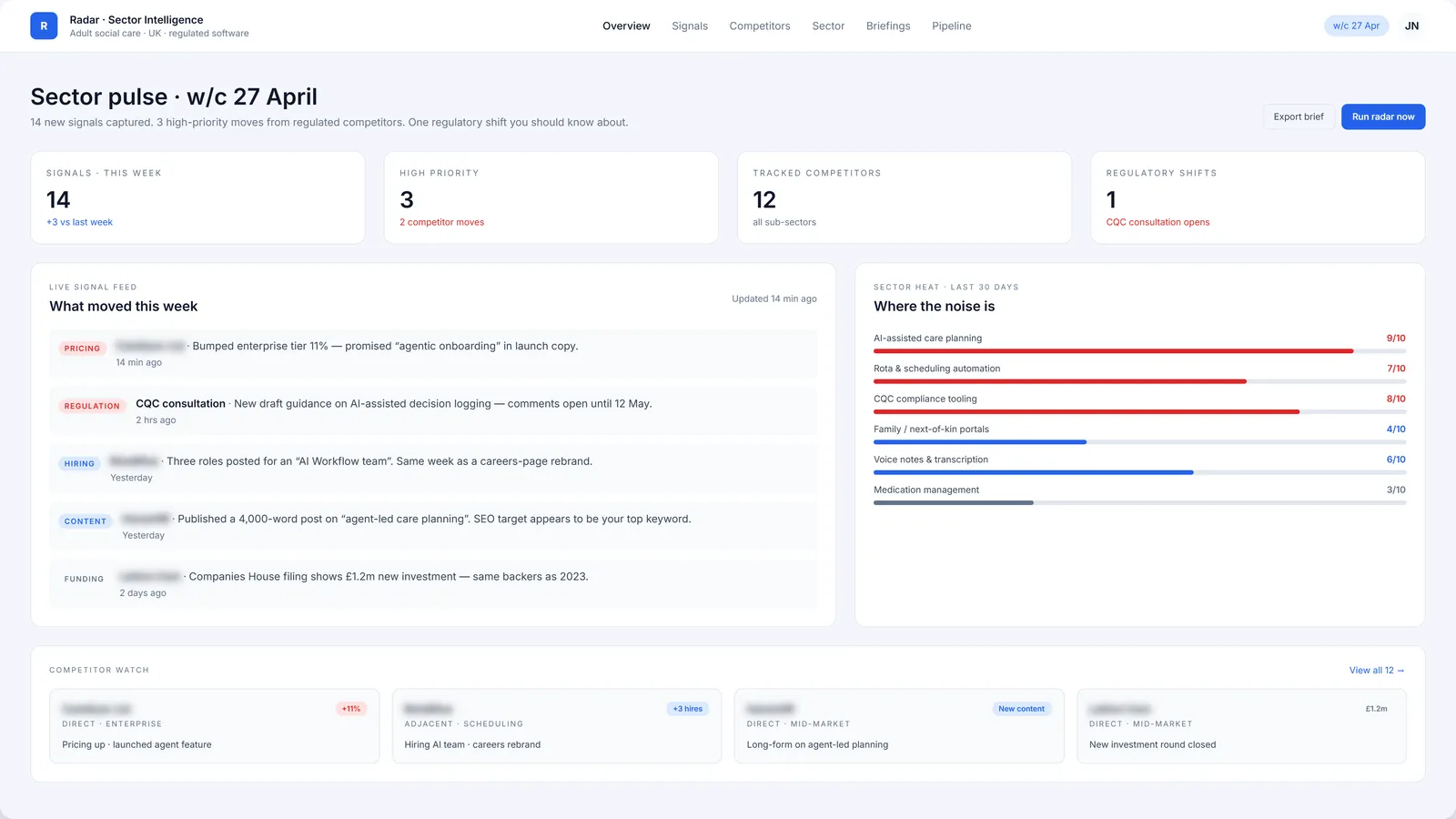
Sector pulse · weekly overview
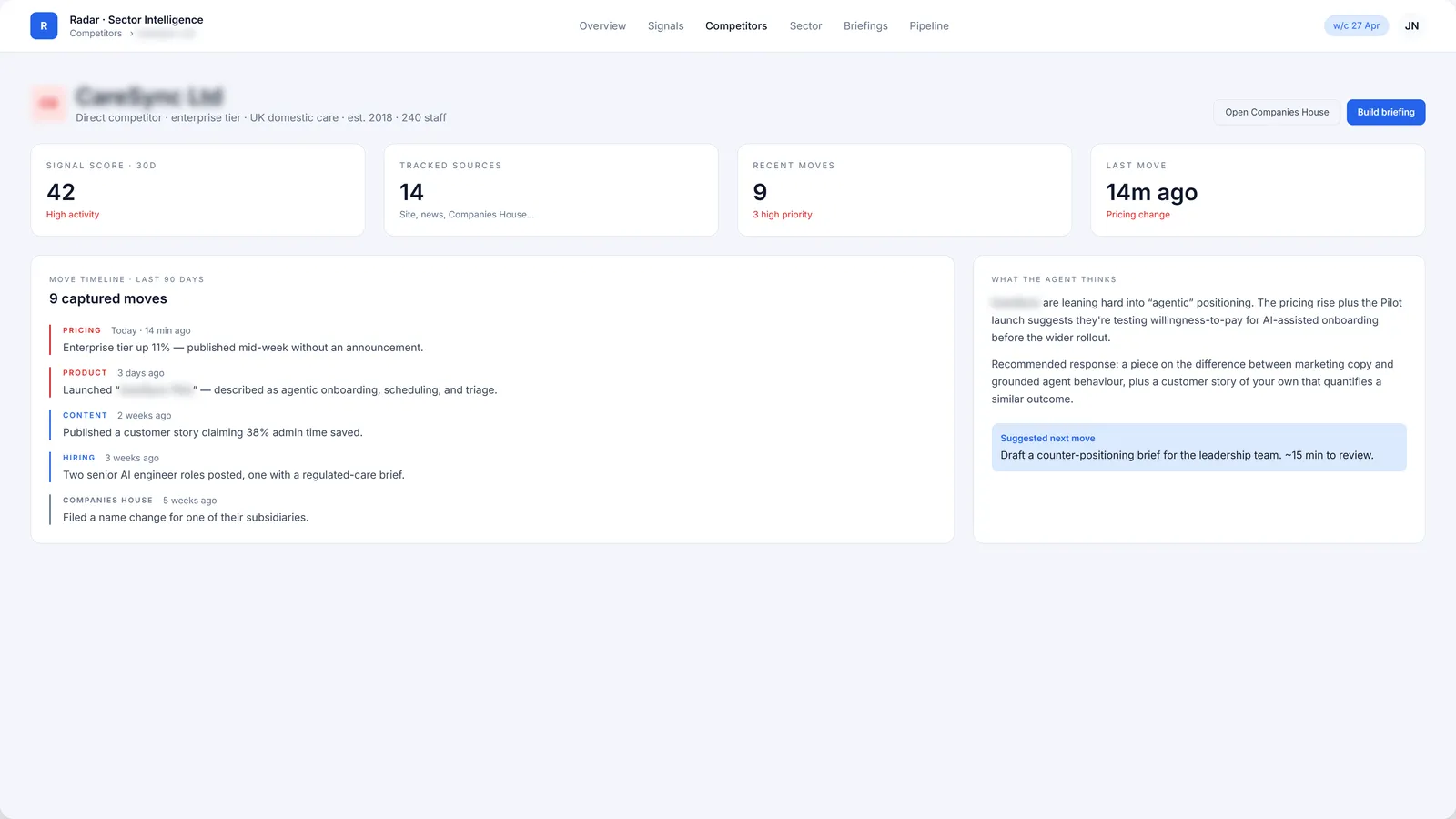
Competitor deep-dive · 90-day move timeline
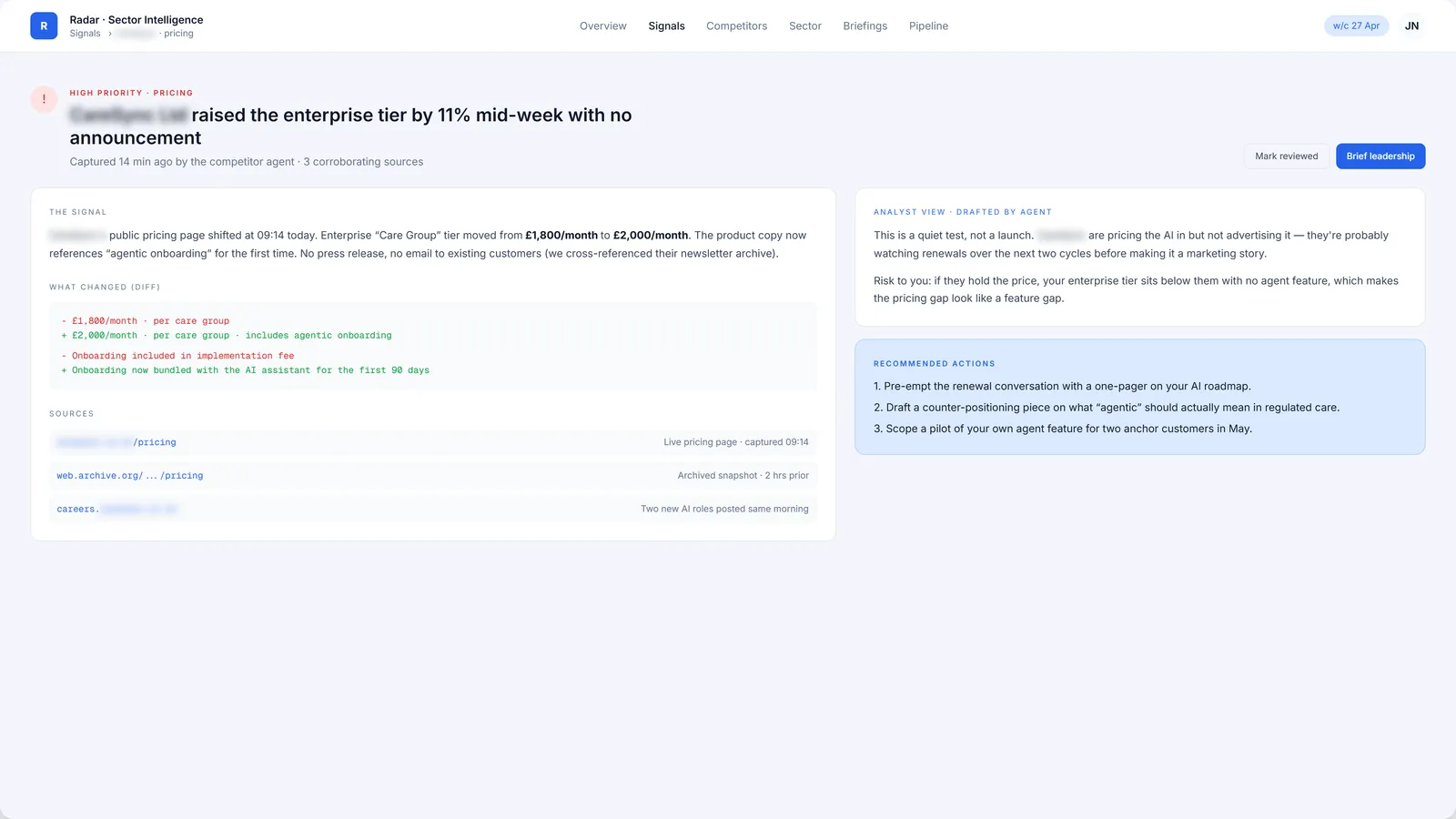
Signal detail · with sources and analyst view
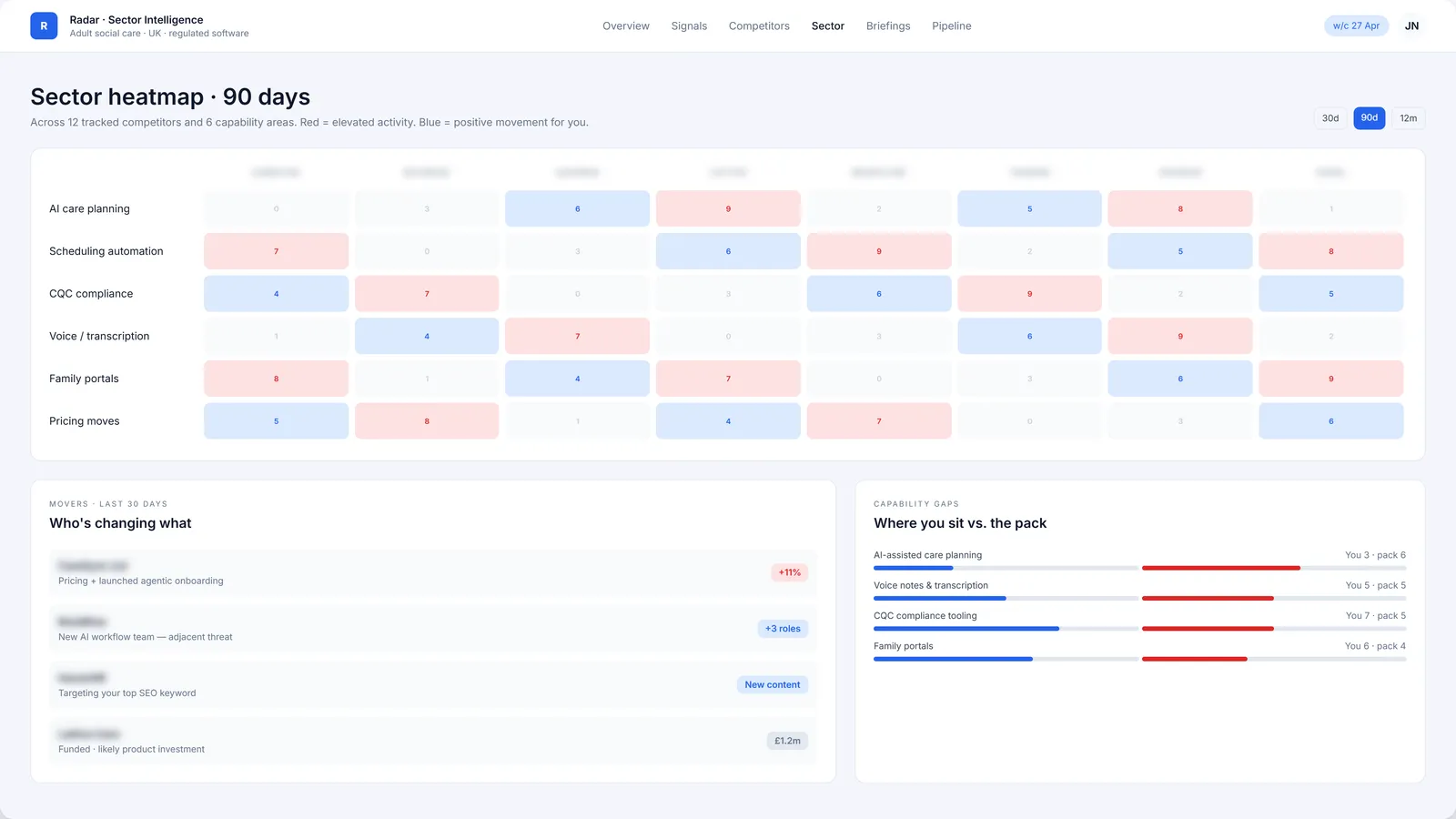
Sector heatmap · capability gaps
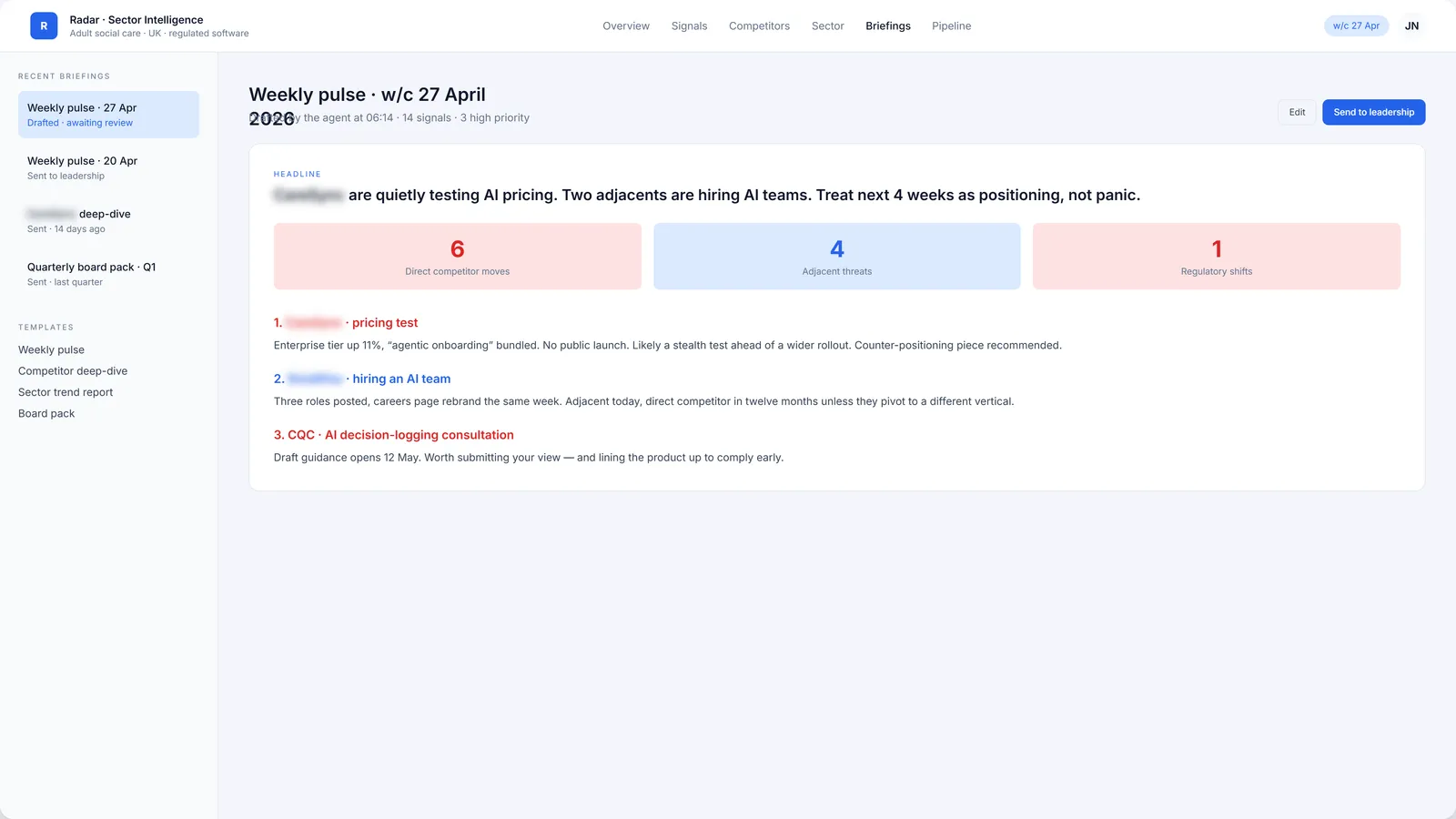
Weekly briefing drafted by the agent
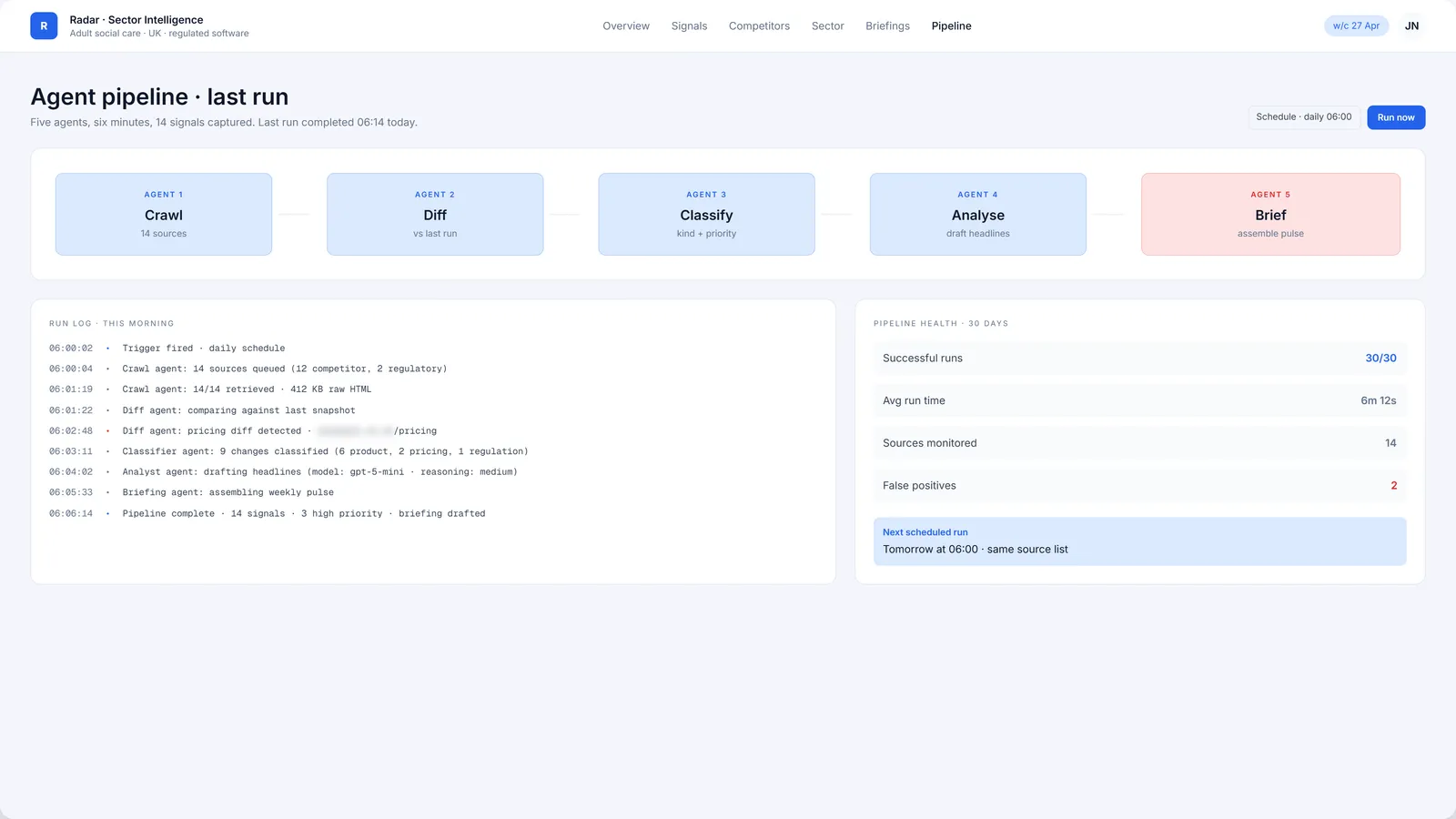
Five-agent pipeline · run logs and health
At a glance
- Industry
- UK adult social care software
- Team size
- Small leadership group · single internal user
- Mode
- Build · multi-agent pipeline
- Status
- Live, in active use as a weekly radar
- Friction type
- Hours of manual reading every week, gaps between sweeps, and no record of who saw what. Discovery of new entrants happened by accident, usually too late.
The problem
On the surface, the leadership group needed a weekly read on the market. Underneath: a manual sweep that didn't scale, no structured record across weeks, a discovery gap on new entrants, and signal lost in volume. They'd tried saved searches, RSS aggregators and a tracker spreadsheet. None of it survived contact with a busy week.
The solution
A single-command agentic pipeline that runs seven specialised agents in sequence, merges the output, and produces three artefacts every run: a deduplicated dataset, a full-text evidence document, and an LLM-generated leadership briefing of the items that actually matter.
Competitor Discovery
14 sector-specific search queries, results passed through an LLM classifier with a 0.7 confidence threshold. Anything below the bar gets dropped. Bidirectional substring dedup against existing names.
News Scraper
30+ feeds across regulators, sector media, compliance and workforce publishers, care-tech press and AI-platform blogs. Articles scored against three keyword buckets.
Competitor Blogs
Scrapes the blog page for every known and discovered competitor. If a blog URL is missing, it probes six common paths and persists the first that returns 200.
LinkedIn Intelligence
Site-restricted searches for each competitor name plus general industry phrases. Snippets only, but enough to flag announcements and partnerships.
Funding Monitor
General funding queries plus per-competitor queries. Score bonus applied because funding moves are leading indicators.
Job Monitor
Hiring queries classified by signal type, AI/ML, Product, Compliance, Sales, Customer Success. Hiring tells you what is shipping next.
Review Monitor
Site-restricted searches across G2, Capterra and Trustpilot, both general and per-competitor.
What it deliberately isn't
An autonomous decision-maker. The pipeline does not act on what it finds. It collects, ranks, summarises and links. Every claim in the briefing has a clickable source. Every full article is preserved as evidence. The leadership team still reads and decides, the system removes the sweep, not the judgement.
The outcome
- Sweep effort, from multi-hour manual scan across 30+ sources to one command.
- Coverage, every run touches the same source list. No source skipped because the week was busy.
- Discovery, 75 candidate competitors auto-classified and persisted, each with a confidence score and a one-line reason.
- Signal density, 200+ items collapse into 10 to 15 prioritised summaries with clickable sources, ordered by sector relevance.
- Resilience, per-agent exception isolation means a failing source doesn't abort the run. The pipeline always produces output.
Got an idea like this in your own business?
Sketcha is a quick, no-pressure way to talk it through. Tell me where things are sticking and you'll walk away with a sketch of how a system could look, including a flow diagram of the AI bits.